To those loyal followers of my philosophies:
Though I have enjoyed myself in the 21st century, my time is short. I only have time for this final blog post. In it I will do my best to summarize what I have already told you, so that you will not forget. Most importantly: a state of nature must be avoided at all costs. We must have government to prevent anarchy. Lack of rule is the first step towards a state of nature. As proved in the cases of Lord of the Flies or The Lost Boys of Sudan, lack of steady rule results in chaos, scarcity, violence, and death.Government is the only thing that stands between us and a state of nature. Though government has the natural tendency to be corrupt, as everyone is selfish and egotistical, we must still adhere to solid rule. It is far better than the alternative. We all think for ourselves. Even if you try to deny it, you are still in it for yourself. This is simple human nature.In a state of nature we would solely be ruled by our natural instincts, this is what would destroy us all. Instead the rules and laws of society give us some structure in an otherwise chaotic world.
Friday, January 14, 2011
Conclusive Farewell

Wednesday, January 12, 2011
III Greater Understandings
"Philosophies of leadership are determined by beliefs about human nature."
Explanation:
Human nature determines how everyone will act. An understanding of human nature, determines how others will react to your actions. This continuous loop of action and reaction is a basis for all functioning of mankind. There are multiple philosophies on human nature, based on what your theory of human nature is, will influence how you expect leaders to act and react. Leader must satisfy others, which in turn benefits their own power. For example one leader may increase the quality of healthcare for their nation, this would please the people, and indirectly boost their power and approval. This understanding of how a leader will act allows you to determine your philosophy based on that nature.
Opinion:
All humans are selfish. It is base human nature to act and think for yourself at all times. People are always considering how what they do will affect what happens to them. Leaders, despite having superior power than most, still function under the same basic principles. They will think of themselves in the actions, though they will try to please the people in order to maintain power. This allows a certain margin for corruption and selfishness from leaders, this is to be expected and should be accepted. Even a corrupt leader or government is superior to no government at all. Anarchy results in a state of nature, and without any higher power, our natural tendency towards selfishness will destroy us.
Trujillo was a cruel dictator that ruled the Domincan Repbulic, before it became a Republic. Despite this, he still kept the country in better order than if it had no government at all.

These are children soldiers in Somalia, during it's time of anarchy. This is the basically a state of nature. Even Trujillo's cruel government was an improvement over this.

"The governed have a responsibility for their governance."
Explanation:
Government gives certain benefits to their people. They expect the people to repay them, such as giving up certain rights and obeying the laws. If the people want to be under their governments protection they owe them loyalty and obedience. In CVU the students are given a wide range of responsibilities and freedoms, in return they are expected to obey the rules of the school and behave appropriately. This is the same core relationship that exists between all leaders and their followers.

Government prevents anarchy,the worst possible fate for humanity is total anarchy. This will result in a state of nature and destroy us all. Due to the fact that government maintains balance and order, we (their subjects) owe them loyalty and must sacrifice certain rights and abilities in order to be under our government's protection. This allows us to better survive and live our day to day lives. If we do not tribute our government, then they cannot be expected to provide for us in return. Below is a video that symbolizes this type of exchange: in a videogame, one character is down so the other revives him and helps him to kill another enemy.
"Human Nature does not determine our actions,: it inclines us towards us towards certain actions."
Explanation:
Human nature is the base instincts and tendencies of our race.The key term is "base". There are many more levels of complexity to human beings than just their instincts. They function on a higher plane of thought, and therefore are not solely influenced by their nature.If I want a new phone that my friend happens to possess, I do not simply go and take the phone. Instead I keep in mind the negative effects this could have on my relationship with my friend and how others perceive. Instead I save my money to purchase the phone, which is the generally accepted social construct. There are expectations from society and from individuals that rest upon us, we must consider the affects that adhering to or ignoring these expectations will result in. Factors such as these all influence our behavior at all times.


Opinion:
It is human nature to think to benefit yourself. Everyone does it, however as society continues to evolve, they do it in more complex ways. Leaders obtain and hold power by satisfying and promoting their people, salesman obtain money by constructing and marketing successful products that satisfy people, and celebrities increase their fame by participating in successful products that are well received. All of these methods are selfish in nature, however they simultaneously satisfy others. This is how much of society functions, by utilizing others' wants and needs to benefit them. This is proof that though human nature exists, it does not rule and dominate us. In a state of nature it is highly possible that human nature would be the sole thing determining our actions, but in a society with leadership and laws there are many other factors to consider in our actions.

Monday, January 10, 2011
Boys, Boys, Boys
Lord of the Flies:
Lord of the Flies is an excellent representation of a state of nature until the ending. It is highly improbable, and interrupts the state of nature, not allowing it to play out naturally. Assuming that the boat captain never ended up on that exact island at a most opportune time, here is how the story would have played out. Ralph would have ran onto to the beach, been surrounded, killed, and sacrificed in the name of the best. In the state of nature the boys' society would have continued to devolve. They would run out of pigs for meat, and turned one another. To survive they would have ultimately turned to cannibalism and devoured their comrades. Eventually all would be destroyed, from starvation or slaughtered by the ones they once trusted. This is how the true state of nature would have ended.

The devolution of the boys society in Lord of the Flies, personifies human nature tendency towards savagery and selfishness when left unchecked.
Lost Boys of Sudan:
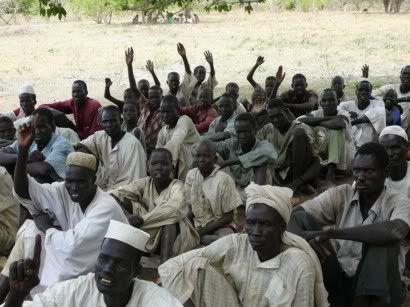
Though Sudan was not in total anarchy, they had no single government to unite them. This left them hanging dangerously close to a state of nature. This resulted in the same effects as a true state of nature: violence, chaos, and scarcity. However this was most experienced by the male children of Southern Sudan. They were exiled from their homes, forced to trek across kilometers of wilderness, and hunted by soldiers. They also faced ravenous beasts, hunger, and dehydration. Though they temporarily reached civilization, once again the government devolved into chaos and they had to flee to another refugee camp. Fortunately the government held together and they were finally safe. Some then emigrated to America and were given better lives. This is all evidence that a stable government always provides a better location than one in turmoil. This also further proves my theory about a state of nature equally a time of scarcity, violence, and chaos.


Thursday, January 6, 2011
I am not a Stuffed Tiger

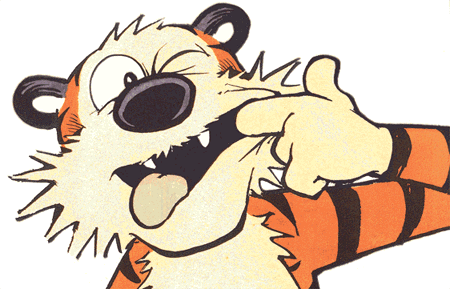
For any of those who are familiar with the comic book Calvin and Hobbes I am not the stuffed tiger Hobbes, from aforementioned series. I am in fact a 17th century philosopher and human in species. This is me:
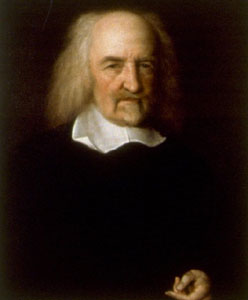
Not this:*though it's worth noting that the cartoonist Bill Watterson named this character after me.
Evidence
A group of young boys stranded on an island. It sounds like such a charming theory. But the result is far different and darker than what you'd expect. There is a self contained state of nature on the island, therefore the boys descend into a state of scarcity, violence, and chaos. To see one of the horrific results: click here. But I caution you that it is not for the faint of heart.
In a imagined view of the prehistoric times, when man was the primitive ape and society had yet to be established, there was also scarcity and violence. In this clip you can see a battle for a small watering hole that two tribes of apes wish to control. Click here to view.
The country of Somalia was without a government from 1991-2006. This threw the nation into a state of uproar and imbalance. Warlords ruled with violence and fear. Many didn't even had access to fresh drinking water and few were literate, both signs of scarcity. This is the kind of chaos that results from anarchy.


Introduction
Due to the ambiguity of the word "nature" you may be wondering as to what I'm referring. By "state of nature" I mean existence without rules, regulations, and expectations. For any who picture a quaint little utopia, you could not be more wrong. A state of nature would be a time of scarcity, chaos, and violence. Anarchy must be prevented at all costs, because this would result in a state of nature.
Government and leadership is crucial to prevent anarchy, in a world where everyone is in it for themselves, we need a third party to regulate and monitor us. Now even those in power are corrupt, but corruption is still a less objectionable outcome than anarchy and chaos.
This is the idea of a "social contract"; we agree to give up some of our rights to a leader who will guide us and keep everything somewhat orderly. For those that do not take to this idea, I bring to mind again the notion of death and destruction that would result if there were no one to rule us, and a state of nature arose. We must do everything in our power to prevent this outcome.